

FAQ's
New Wells
Existing Wells | General | Helpful LinksHow do I know that the lot I'm planning to build on will have "good" water?
Water quality can vary from location to location so it can be very hard to know for sure what the quality of water at your site will be. Through our experiences drilling in the Northwoods area and from servicing other wells, Jelinek Well Drilling has a general idea of what the water quality may be. Another way that you can investigate the quality level is to ask neighbors how their water is. Want to know more? Contact Us
How close to my house does the well need to be (or how close to the well will my house need to be)?
Distance from the home to the well is not a big issue. At Jelinek Well Drilling, we generally try to place the well between 10' and 15' away from the home to keep trenching costs down. Want to know more? Contact Us
How long does it take to get water at my new home?
Depending on well depth and ground formation, it usually takes 1 day or less to drill the well and an additional day for the pump crew to hook it up and bring water into the home. Want to know more? Contact Us
Do I have to coordinate your crews with other contractors at the building site?
Yes. As with any construction project, coordination between subcontractors is important to avoid having one crew being in the way of another. For instance, it's better to have the well pump and tank installed and ready for the plumbing contractor to finish before they are on-site to avoid them having to return to complete their work. Want to know more? Contact Us
What is the difference between a drilled and a driven well?
A drilled well is usually 6" in diameter, has a submersible pump and generally has more water pressure and volume. A point (driven) well is usually 2" in diameter and has an above ground pump. A drilled well is much easier to start up and shut down for seasonal cabins. Want to know more? Contact Us
How deep will my well be?
In our area, the average wells range from 60'-80' in depth depending on elevation and geology. Wells can be as shallow as 25' or as deep as 350'. Want to know more? Contact Us
What possible sources of contamination do I need to be aware of while locating my well site?
There are certain setbacks for septic systems, sump basins, and old landfills. Please contact us for specific setbacks that you may need to be concerned with. Want to know more? Contact Us
What basic codes should I be aware of while planning my new well site?
Though there may be more codes depending on your location, you will need to have your well at least 25' from your septic tank and sump basin, if applicable and 50' from your septic drain field and alternate site. Want to know more? Contact Us
My new well tastes funny and it looks rusty - what's going on?
There will be a temporary taste from the new pipes and fittings used. It should go away in a couple of days with water usage. You will have rusty water for 2-3 months (possibly as long as 6 months) - this is from the new well casing. When we drill, it sandblasts the inside of the well casing down to bare steel. This will emit rust particles until the time that a solid rust lining is built up in the well. Using a lot of water will help clear it up quicker. You can also run a garden hose at 2-3 gallons per minute to allow the pump to cycle thereby creating a "washing" effect in the well. You may run a hose like this for days providing the well has an adequate supply. Please call or e-mail for more information. Want to know more? Contact Us
Existing Wells
New Wells | General | Helpful Links | TopI'm worried that my existing well is contaminated - now what?
If you feel that your well is compromised, please contact us to determine the problem and a remedy. You may also contact your local DNR Private Drinking Water Section - they are there to help you so don't be afraid to call. The Northern District's phone number is: 715-365-8900. Want to know more? Contact Us
My well water tastes/smells "funny" - what can I do?
If your well is not contaminated with anything unsafe you have a number of options from a variety of water conditioner companies. Additionally, it is possible to redrill into a different aquifer water source. Jelinek Well Drilling offers well chlorination services for the treatment of iron bacteria and to disinfect your well. Click Here for more information.
General
New Wells | Existing Wells | Helpful Links | TopIs Jelinek Well Drilling a licensed well drilling firm?
Yes. State law requires that drilling firms be licensed in the state they are drilling in. Currently, Jelinek Well Drilling is licensed in Wisconsin. Want to know more? Contact Us
Is there a guarantee on the quality of water from my well?
Unfortunately, due to geological conditions water quality and quantity cannot be guaranteed. Want to know more? Contact Us
How long will my well produce water?
If constructed properly and depending on water characteristics, a drilled well can last the homeowner's lifetime. Want to know more? Contact Us
What other services does Jelinek Well Drilling offer?
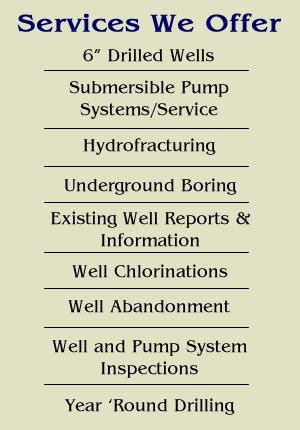
We offer the following services: hydrofracturing, submersible pump service and replacement, underground boring, well and pump system inspections, well abandonment and shock chlorination of wells. Want to know more? Contact Us